Things I learned about 1x10 conversions on old-school MTBs
OK, one more bicycle post before I get back to that Rover P5.
So I built this.
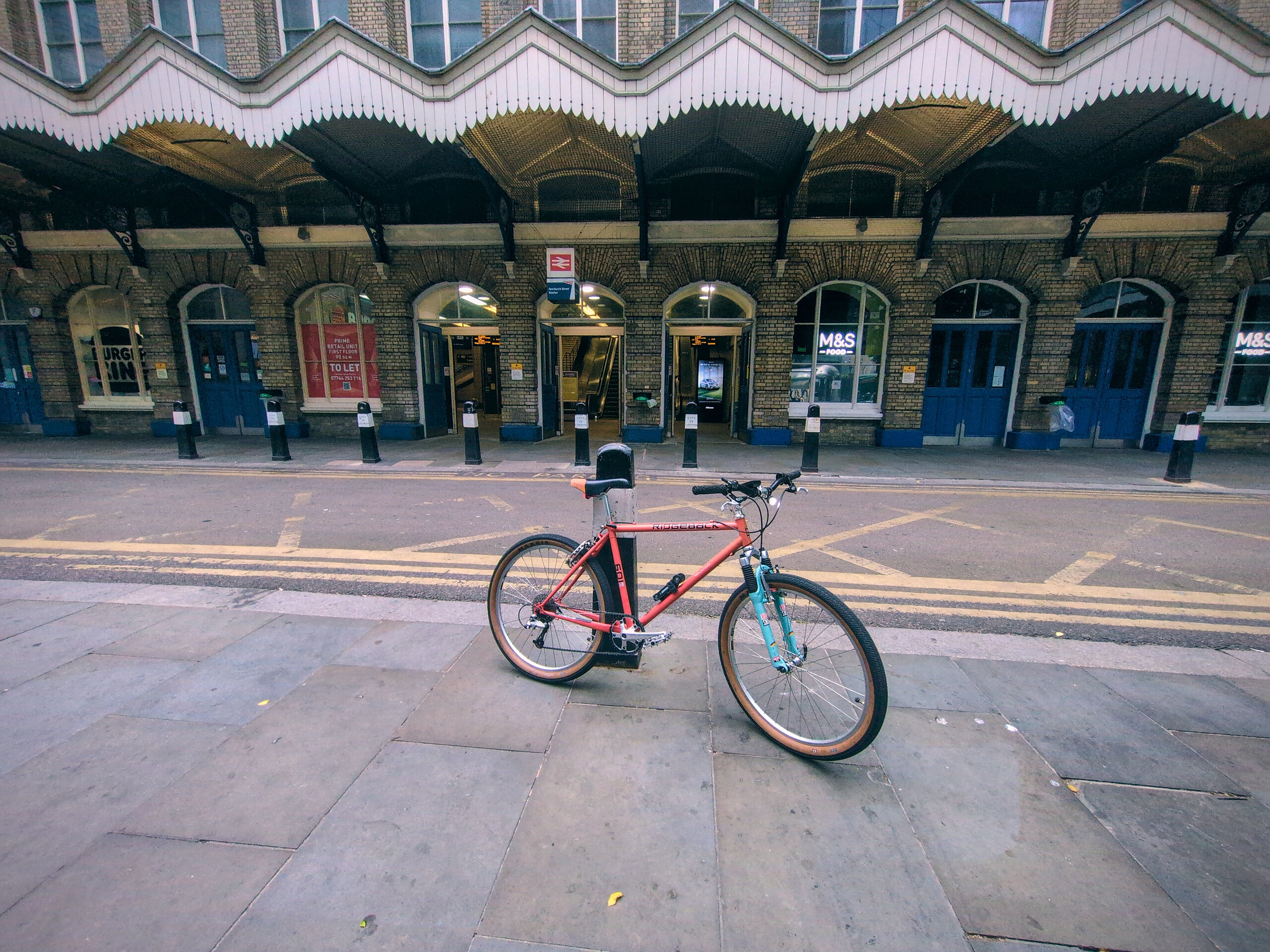
I briefly spoke about it before. It was a sad-looking Ridgeback 601GS from 1991. I rebuilt it into a bike for the road, with geometry and controls chosen to match the other Ridgeback as closely as possible, but with more pragmatic choices of parts.
Pragmatic means less blingy, because I didn't want to burn another four figures on another two-figure bike. But pragmatic also means that I'm willing to make some compromises with "modernity" (this is defined as "after the year 2000" for people my age), if the advantages are compelling enough.
So it is with the 1x10 drivetrain on this bike. 1x10 drivetrains didn't exist in the 1990s, and are feasible today. Bikes back then usually had 3 rings on the chainset, paired with 7 or 8 on the rear (9 right at the end of the 1990s). The much wider gear range of rear cassettes today (compared to 1991) means that for most real-world riding we can dispense with gears on the front altogether, and the larger count of gears means there aren't gigantic jumps between them.1 That means fewer components, which means less maintenance and less weight.
Stop right here if you don't have a steel frame
The space between the dropouts on bikes which have a 7-speed rear is usually 130mm. For 10-speed (actually 8-plus-speed) rears, it's 135mm. You will need to bend your frame outwards a little to space the dropouts if they are at 130mm. You MUST NOT attempt this on aluminium, titanium or plastic-composite2 frames. If you have a frame made of anything but steel, measure the space between the dropouts on the inside. If it is 130mm, don't attempt a 10-speed conversion.
Steel is rather forgiving of being bent out by 2.5mm on each side. Other bicycle frame materials are not. Fortunately, by the time more exotic materials became common in the 1990s, 8-speed rears (which are the same width as 10-speed rears, as we'll see in the next section) were becoming available, starting with XTR M900 in 1991. That means the more expensive frames were often built with 8-speed rears in mind. You'll probably be fine; just measure it.
Freehub bodies
The easiest way to get a wheel which accommodates a 10-speed freehub body is to buy a complete 8- or 9-speed wheel. You can skip the rest of this if you're starting from scratch as I did (because I bought the Ridgeback for its frame and replaced every other component).
To convert a rear to 10-speed, you must have an 8- or 9-speed freehub body. They're the same width as 10-speed freehub bodies; 7-speed ones are narrower.
Hopefully, you have a wheel with a separate HG-type freehub body. Very old and very cheap bikes will have a freewheel, which is a single assembly with both the sprockets and the ratcheting mechanism. There are allegedly 10-speed freewheels with very limited gear ranges from weird brands I've never heard of, but you're probably better off replacing the wheel in this case.
There is no such thing as a standard 10-speed freehub body; I can think of at least four different incompatible designs of engagement with the wheel and there are probably more. The most common on 1990s bikes is this type with a recessed-10-tooth engagement on the wheel; note that the "teeth" here are actually recessed into the freehub body, and do not stick out.
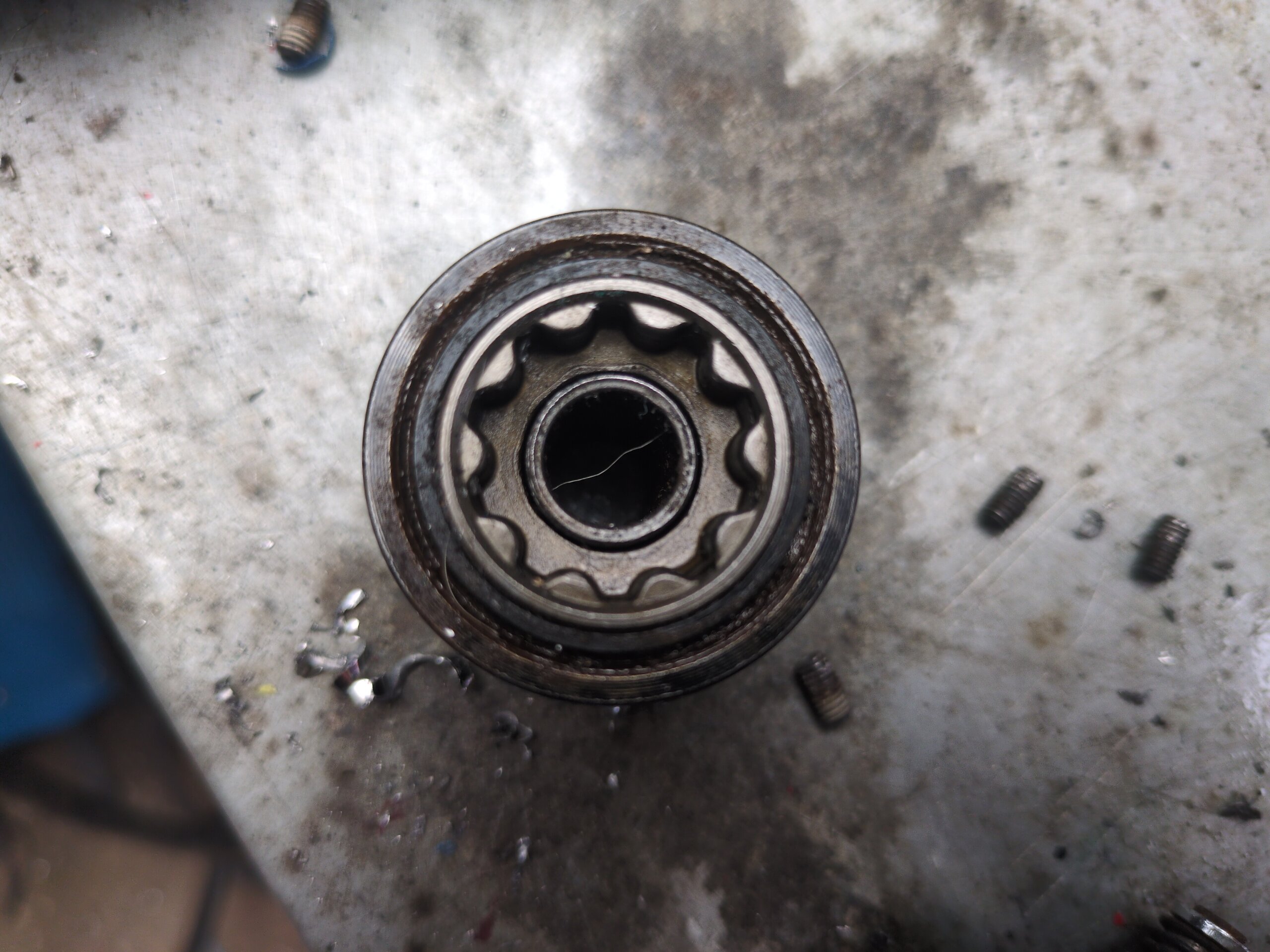
These are harder to obtain than you might think, given that some variant of them was fitted to all Shimano hubs for a decade. I had cause to replace mine (the wheel was already 10-speed compatible, but a bad thing happened to the one that was fitted to it). Finding the correct one for my STX-RC Parallax hub was impossible and I ended up buying a complete donor hub from a slightly later generation of Alivio.
If you have a freehub body with this kind of engagement and you can't find the correct one for your hub, here's what I think will work (but have not tried). Buy a freehub body from a Deore FH-M595 hub; this is still available today. Buy the complete axle assembly too, also still available. Fit the freehub body, and fit the wheel with your new axle and drive-side (right-side) cone stack, but use your original cone on the other (left) side.
Even if you do find a freehub body, there's a chance you might need to replace your axle too. If your frame is not already spaced at 135mm, then take a look at the sticky-out bit at the end of the axle which slots into the dropouts. If you don't feel that you can safely subtract 2.5mm of axle from each side, then you'll need a longer 8-speed axle.
You might as well replace your wheel bearings while you're there; it'll actually be less effort, because you won't have to keep track of your old ones and then clean them up.
You aren't done yet! 8-plus-speed wheels are dished slightly differently to 7-speed ones. That is, with your new freehub body assembly your wheel will now sit over to one side inside the frame, which will probably manifest itself as the tyre rubbing on the chainstays. You will need to have your wheel re-dished, and if you're like me and bad at spokes that means getting someone to do it for you.
See what I mean? It's always going to be less effort to buy a wheel that already has an 8-speed freehub body, and keep your old wheel for the next project (there will always be a next project). Oh, but even then you're not necessarily out of the woods because it turns out that on some bikes -- and I know some full-suspension Saracens are among them -- the original 8-speed wheels have 7-speed dishing for strength and instead have chainstays that are slightly kinked outwards on the drive side, which manifested as exactly the same problem I'd have had if I'd converted a 7-speed wheel.
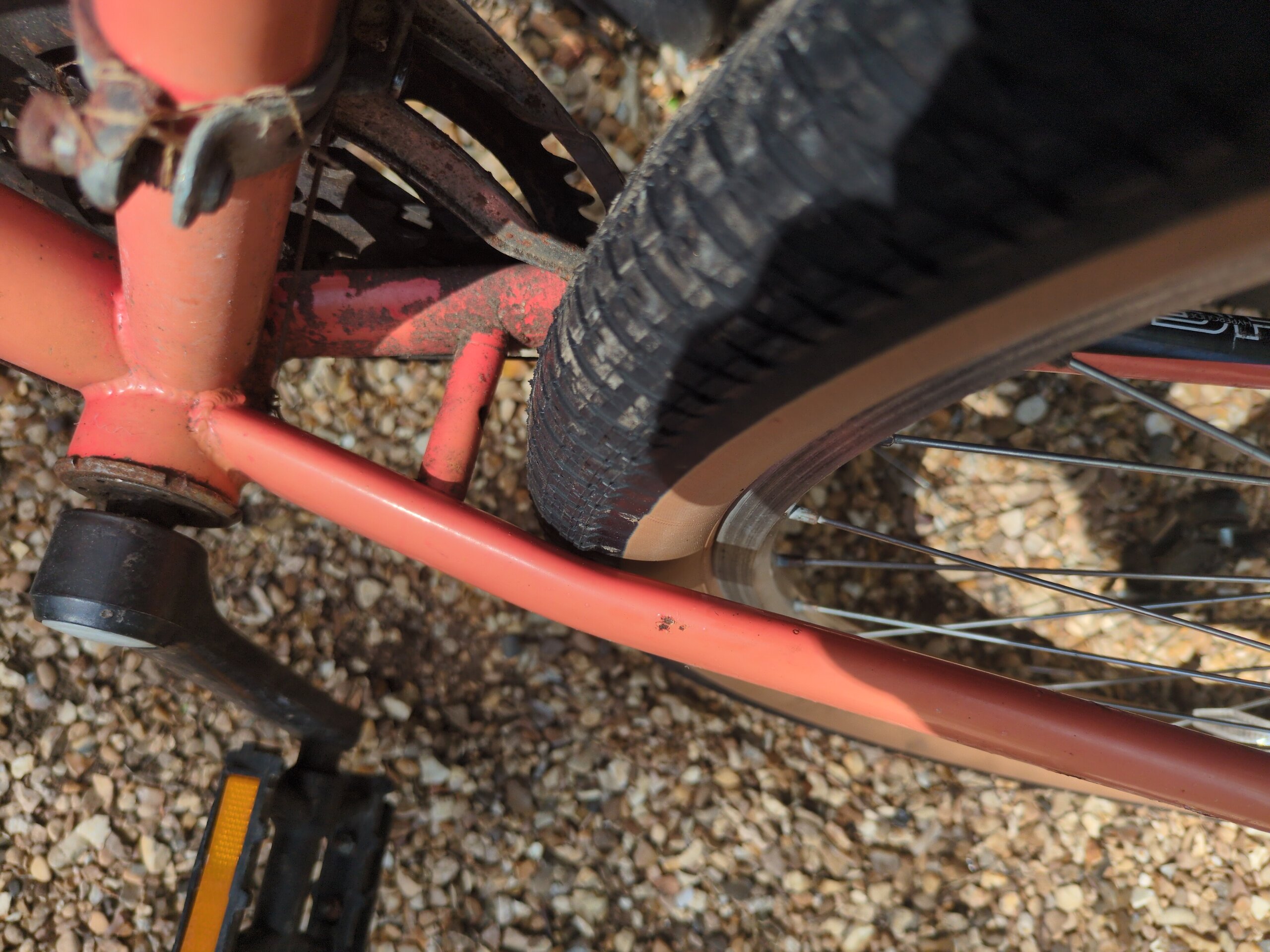
So I had to send that wheel off to be re-dished and it turned out that the wheel had a gigantic flat spot and was thus unusable, resulting in a 260-mile mission to get another pair of wheels on a Sunday night in a mad rush to get the bike ready for Monday morning.
Bikes are weird!
Cold setting your frame (or don't)
As mentioned, 8-plus-speed wheels require that the frame has about 135mm of space between the dropouts, and 7-speed ones have 130mm. Measure yours. There is a process called cold setting for bending the frame outwards by 5mm if you have to. You can read a good post about it elsewhere.
The reason you can read about it elsewhere, rather than here, is that I didn't bother. There was enough flex in my frame that I could just pull the chainstays apart while dropping the wheel in.
On narrow-wide chainrings
For a single-chainring front, you will want a narrow-wide chainring. They're called that because they have alternating narrow and wide teeth; the wide ones go in the wide gaps in the chain links, and the narrow ones go in the narrow gaps. It's almost self-explanatory when you see one in person.
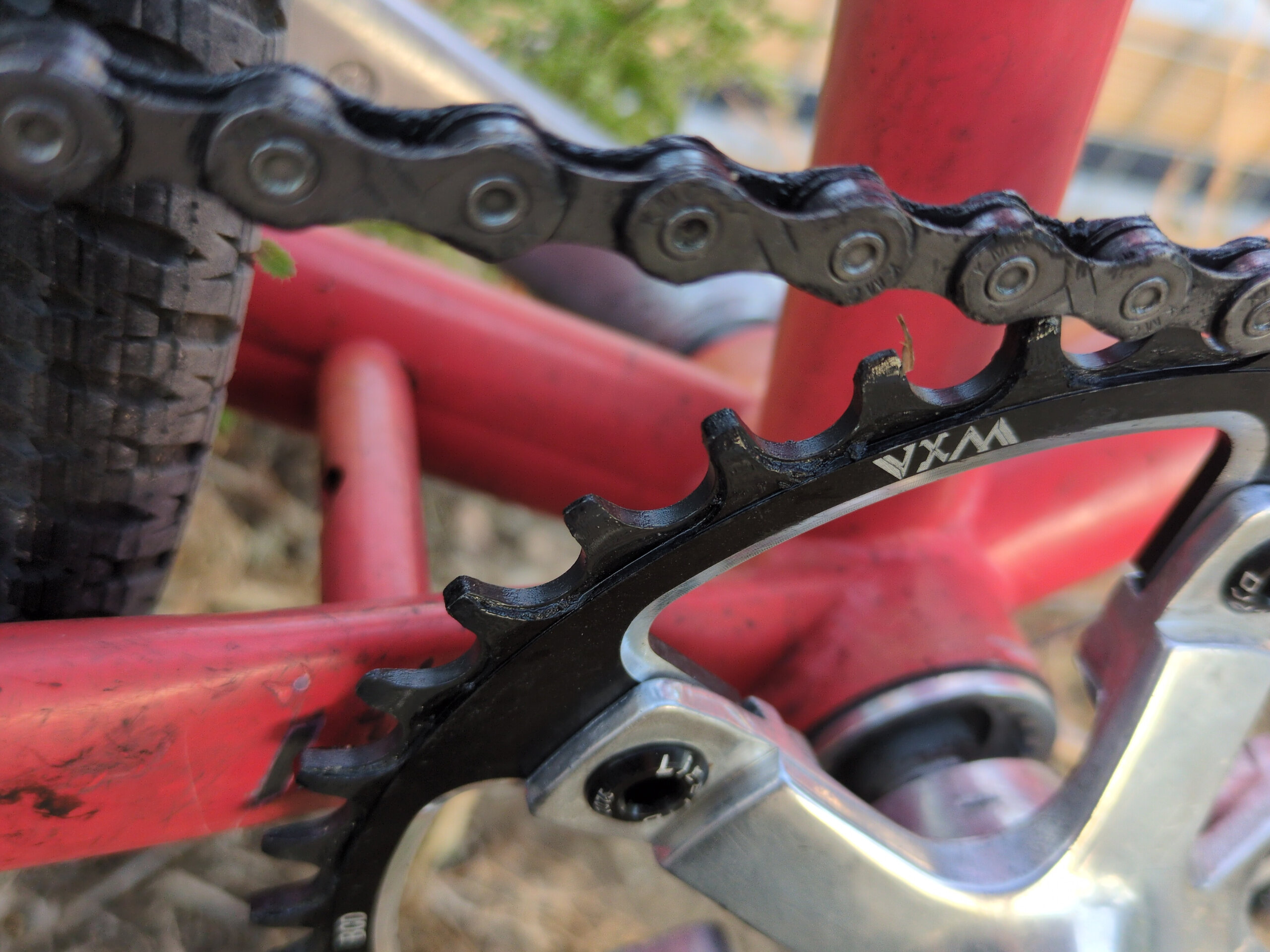
On a 1x10 you won't have a front derailleur anymore, and on a multi-speed front the derailleur stops the chain from falling off at its upper and lower extremes. And remember that, in a sense, the middle chainrings of multi-ring chainsets are designed so that the chain falls off them easily; otherwise, they wouldn't have slick gear changes. A narrow-wide chainring grips the chain much tighter; I've not had a chain drop yet.
I use an aluminium Amazon cheapie narrow-wide, and it's fine. I got the cheapie because I wanted to be sure it'd work before committing more serious money; I'll replace it with a much better one from a real brand once this one wears out or bends. You'll need some new, shallower chainring bolts while you're at it; most of the Amazon cheapies have them included.
If you're starting from scratch as I did, then get yourself either:
- A four-arm 104 BCD crank. That would be any late-90s and early-2000s Shimano four-arm crank other than XTR.
- A five-arm 110 BCD crank. That includes many late-80s and early-90s Shimano and Sugino 5-bolt crank arms, and also many Shimano 5-bolt road cranks. I said "many" and not "all"; look it up before you buy any particular crank.
Outside of that, you're going to have difficulty finding chainrings for it. FC-M737 Shimano XT cranks are 94 BCD, for example, and not many narrow-wides are made for that. And mid-90s Shimano STX, my favourite crank design, has some weird 58 BCD setup where the biggest ring bolts to the middle ring, not to the spider. Solving this problem is probably going to be more effort than buying a different crank.
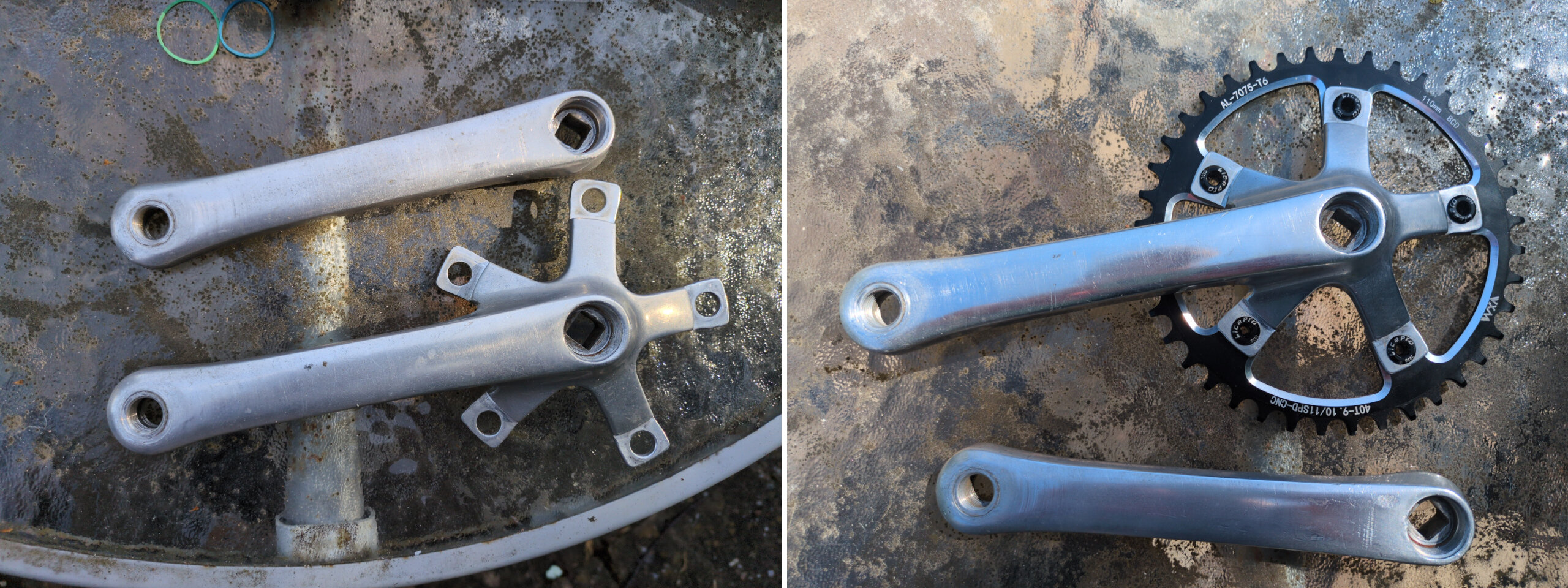
As said, I started from scratch; my Ridgeback had a very heavy riveted-together chainset which didn't allow changing the rings. I got a bargain on some Deore DX FC-MT60 crank arms from 1991, polished them to within an inch of their lives, and put a 40-tooth aluminium narrow-wide on it.
That brings us on to...
Ratios (are easy)
If you don't know where to start, you can copy mine.
The Ridgeback is designed for the road. It has a 40-tooth front ring paired with a CS-HG500 11-34T rear cassette. This is enough low range for any hill I've encountered, it's comfortable at 25 mph on the other end, and it maxes out somewhere a tiny bit north of 30 mph downhill (and a combination of aerodynamics, 2.1-inch-wide tyres and what's left of my common sense would have prevented me from going much faster if gearing didn't).
On the other hand, there's this.
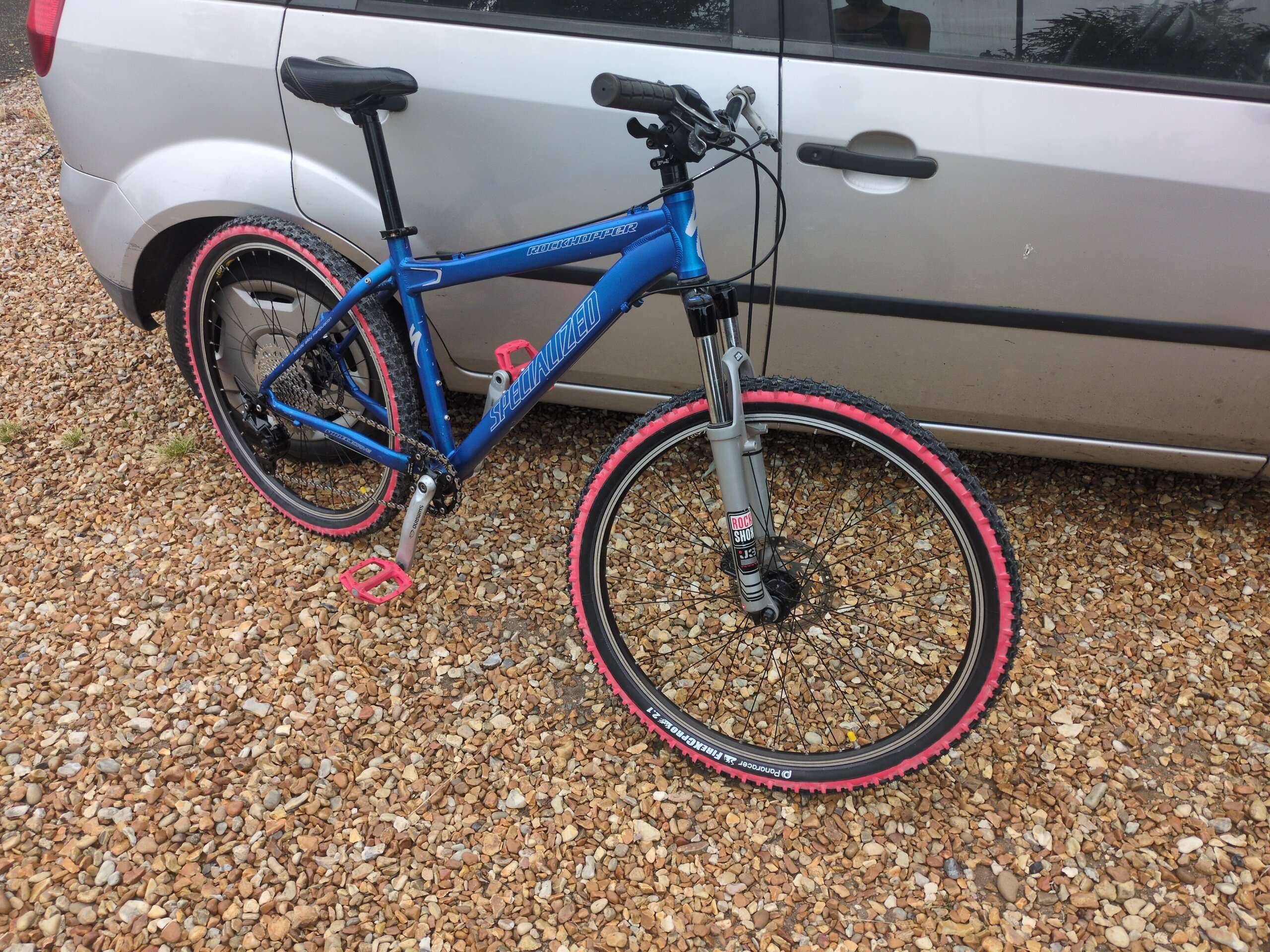
This is a 2003-ish Specialized Rockhopper that I modified for a friend, also with a 1x10 drivetrain, but this time designed for off-road use. It has an 11-46T CS-M4100 rear and a 32T front paired with a modern Deore shifting setup. My friend isn't likely to hammer down hills as fast as aerodynamics will allow, but does want a friendly crawler gear for really tight off-road climbs. That's probably the case for you, too. I didn't run a speedo on this bike when I tested it around Thetford Forest, but calculations imply it's comfortable at 20 mph.
Copy either one of those for your project as appropriate; you'll be fine. Tweak it if you want. For example: if you're intending to use narrower tyres than the 2.1s on my road Ridgeback, you'll have less drag, so you can probably get away with a larger front chainring than 40T and gain a little more top speed. If you have legs like tree trunks (or you enjoy the pain), you can run a larger ring than the Rockhopper's 32T and gain a little more top speed too.
Or just do what I say! I've done the numbers and ridden the bikes so you don't have to.
No Shimano 1x10 setup can fully replicate the range of a typical 21- or 24-speed setup from the 1990s. 1x drivetrains won because at some point in the early-to-mid-2010s everyone collectively realised that it doesn't matter; almost nobody needs crawler gears for 1 in 4 gradients and fast gearing for pushing 30 mph downhill.
There are two important facts here in the Shimano system:
- No Shimano HG 10-speed cassettes for HG freehub bodies are larger than 46T. SunRace make monster rear cassettes that go up to 52T; I don't know for sure what rear mech and shifter pairing you'd need to make that work (but probably an 11-speed-capable Deore rear mech paired with a 10-speed Deore shifter).
- No HG cassette from any manufacturer will have a gear smaller than 11T. That's a hard physical constraint; it's not simply because nobody has thought of doing that yet.
Chainrings, fortunately, can be more or less arbitrarily sized.
You might ask why I didn't go for the 46T setup on my road Ridgeback. While I might not need all that extra range, surely it can't hurt to have it just in case?
Part of the answer lies in the aesthetics of the available rear mechs for 34T sprockets vs the larger ones. I'll explain that in the next section. But also, remember you have the same count of gears on both an 11-34T and 11-46T cassette. If you increase the range of gears, the ratio "gap" between gears increases too. This manifests itself as not quite having the gear you want; one gear being too easy but the next gear up being too difficult. A large gap here feels fine in off-road use. On the road, you are likely to want more gradual transitions between gears.
Derailleurs and shifters
If your mech predates 1998-ish, then it will probably have difficulty accommodating anything larger than a 32T big sprocket. Some people work around this by winding the B-stop adjuster all the way in, but you shouldn't do that; it'll ruin your shifting. You'll want a mech specced to handle the cassette you are fitting.
If you are running no larger than 34T on the rear, then any of the top-normal3 derailleurs in Shimano's "Mega 9" generation will work. Those include the LX RD-M570, XT RD-M750, and XTR RD-M952. Should you do this, you must pair it with a 10-speed road bike shifter which is compatible with Tiagra 4600. No 10-speed Shimano MTB shifter will work with a Mega 9 mech, because they use a different pull ratio. Shifters compatible with Tiagra 4700 will not work either, for the same reason.
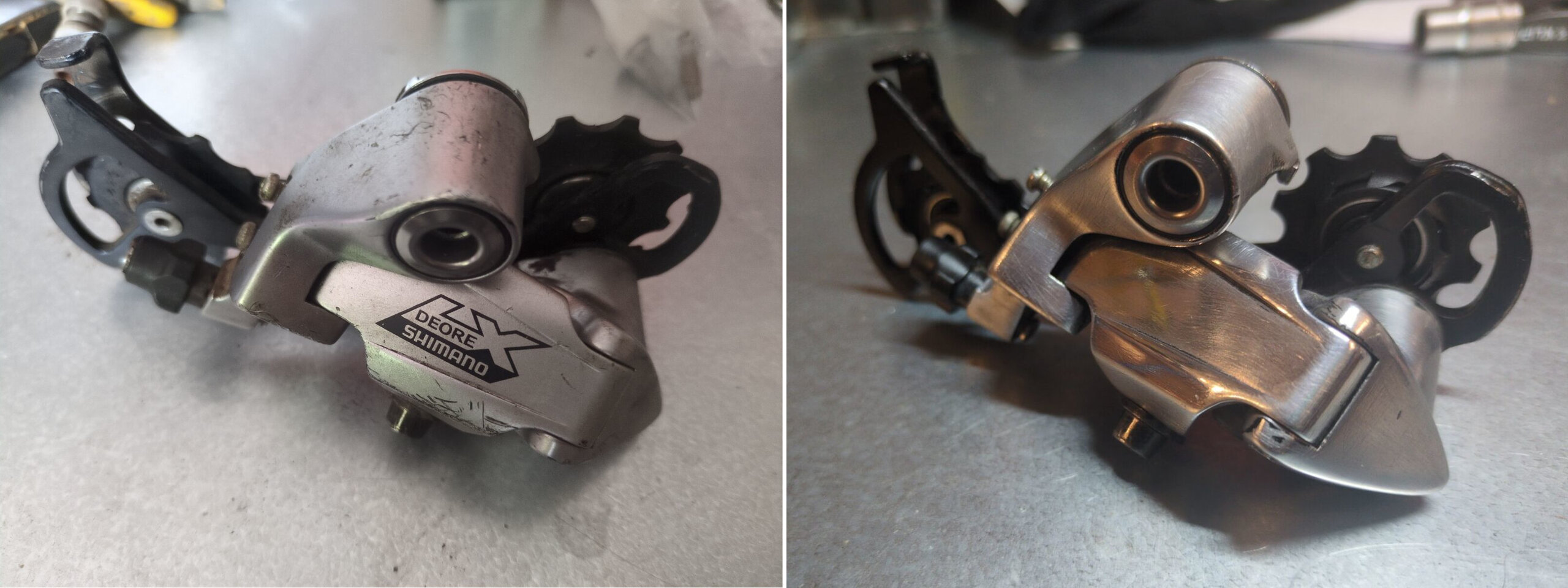
The reason you'd want to use a Mega 9 mech is aesthetics, and specifically the aesthetics of the RD-M570. Because if you use abrasives to strip the boring matte-silver anodising from a scratched-up cheapest-on-eBay M570 rear mech, then use more abrasives to bring it to a shine, you've made a rear mech that does not at all look out of place on an early 1990s mountain bike.
Nice!
If you're going larger than 34T, then you'll have to settle for modern aesthetics on the rear. The easiest pairing here is the SL-M4100 or SL-M6000 shifter with the Deore RD-M5120-SGS mech. That mech will take you up to 46T on the rear. The Deore looks fine for the Rockhopper, and in any case the person I built it for wasn't really chasing pure 1990s nostalgia. It'd probably look out of place on a skinny-tubed frame like my Ridgebacks.
If you don't mind (or actually like) friction thumb shifters, then there's a good chance any of them will work. I haven't tried any of the older thumb shifters; I am running modern thumb shifters in friction mode. I wanted thumb shifters because the other Ridgeback has them; I wanted the controls to be as similar as reasonably possible. At the time I was not versed enough in the Deep Lore of pull ratios, so I picked up this Microshift SL-T10B.
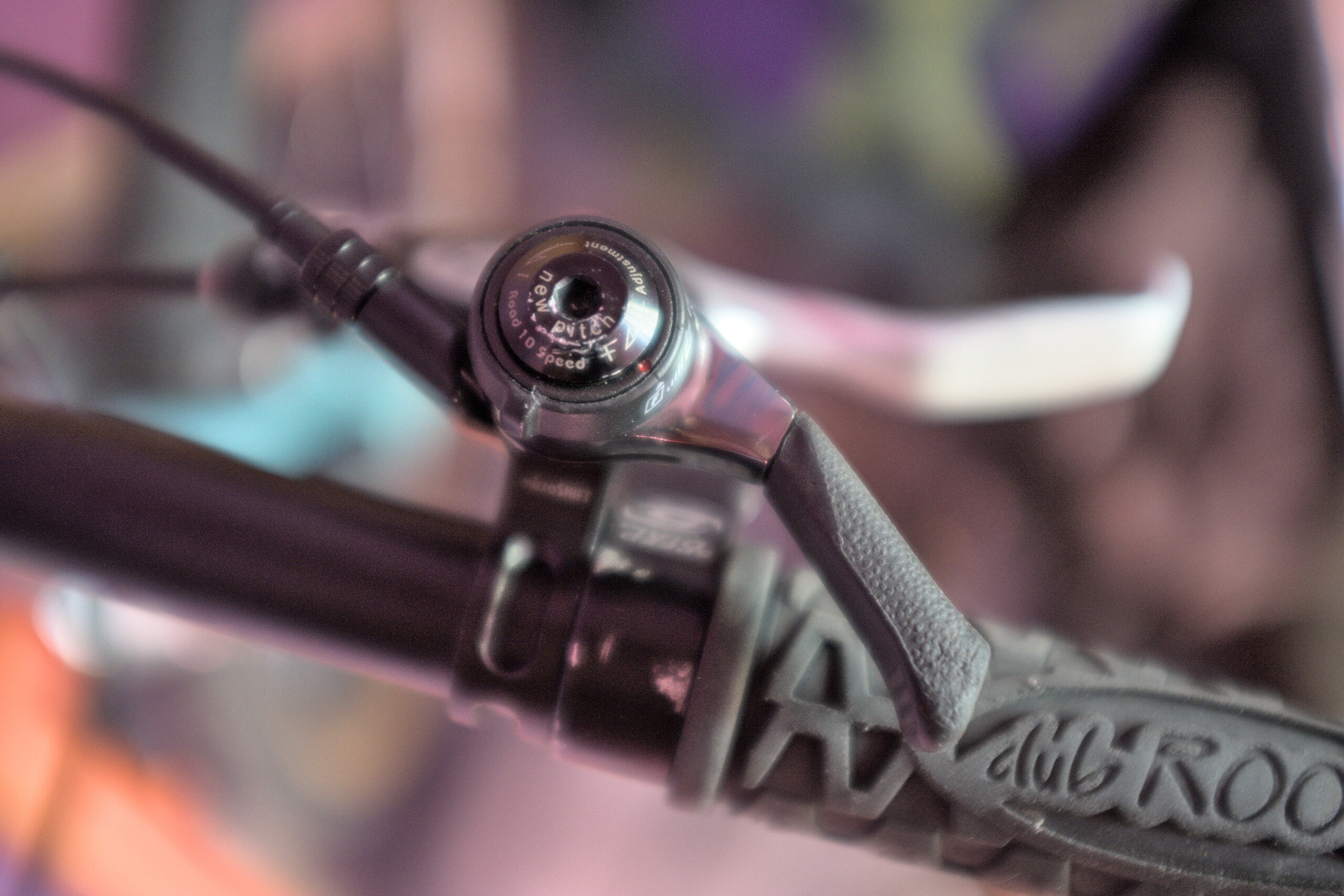
But it turns out that's for the Tiagra 4700 pull ratio; it cannot index with a pre-4700 rear mech (I should have got the SL-T10, no B). So instead of spending another 80-90 quid for the correct one, I moved it to friction mode and used it that way. I learned these lessons so you don't have to!
Chains
You'll need a dedicated 10-speed chain for any of this to work properly. That part is easy: grab yourself a KMC X10. Other brands are available, but all my bikes have KMC chains and they work fine.
For an old-school mech like the M570 used on the Ridgeback, follow the old length rule of "front chainring to largest rear4, plus two links". For clutched derailleurs (like the Deore you'll want for the larger rear cassettes), add four links instead of two.
What about 1x11, 1x12, etc?
11-speed-and-up cassettes are available for HG freehub bodies. There will be some shifter/mech combo that seems to work with them on paper. Try it if you want. I can't tell you what works with what for sure because I haven't built a bike with more than ten gears on the rear.
11-and-more speeds eliminate the ratio gaps I spoke about above. But because they have somewhat tighter spacing, they're also more fussy about alignment and they don't like being out of tune -- just as 10-speed cassettes are more fussy than 7- and 8-speed ones. Then again, I remember the same things being said about 8- and 9-speed back in the 1990s and that never turned out to be a real problem.
Anyway, there's a sweet spot in there that is forgiving of a little cable stretch but also allows wide ratios without giant gaps. I think that sweet spot is ten; you might decide that it is thirteen, or nine. Life would be boring if we were all the same.
Elsewhere
-
Nothing in principle stops 7-speed cassettes from having the same range of gears as 10-speed ones. In fact, Shimano made and apparently still makes "MegaRange" rear freewheels with some fairly wild gear ranges. But the ratio "gaps" between gears -- the delta of pedalling effort required as you change gears -- become rather enormous. A 10-speed rear allows the gears to be more evenly spaced. ↩︎
-
This includes carbon fibre (which is actually carbon-fibre-reinforced plastic). Other more exotic composite materials have been used on bikes. No composite will take well to any attempt to bend it, so I use the umbrella term. ↩︎
-
"Top normal" or "high normal" means that the spring of the mech naturally returns the mech to the smallest cog on the rear, which covers every Shimano mech (and almost every other mech too) until the late 1990s, and most of them after that too. "Bottom normal" or "low normal" means it returns to the largest cog. Shimano pushed low-normal from 1998 onwards under the name "Rapid Rise", and gave up on the idea a few years later because it was, for various reasons, bad. Because they gave up on "Rapid Rise" before 10-speed systems came around, no low-normal mech will work properly with 10-speed shifters; the shifter will operate your gears in reverse. ↩︎
-
On multi-speed chainsets this is largest front chainring to largest rear, but you only have one chainring, of course. ↩︎